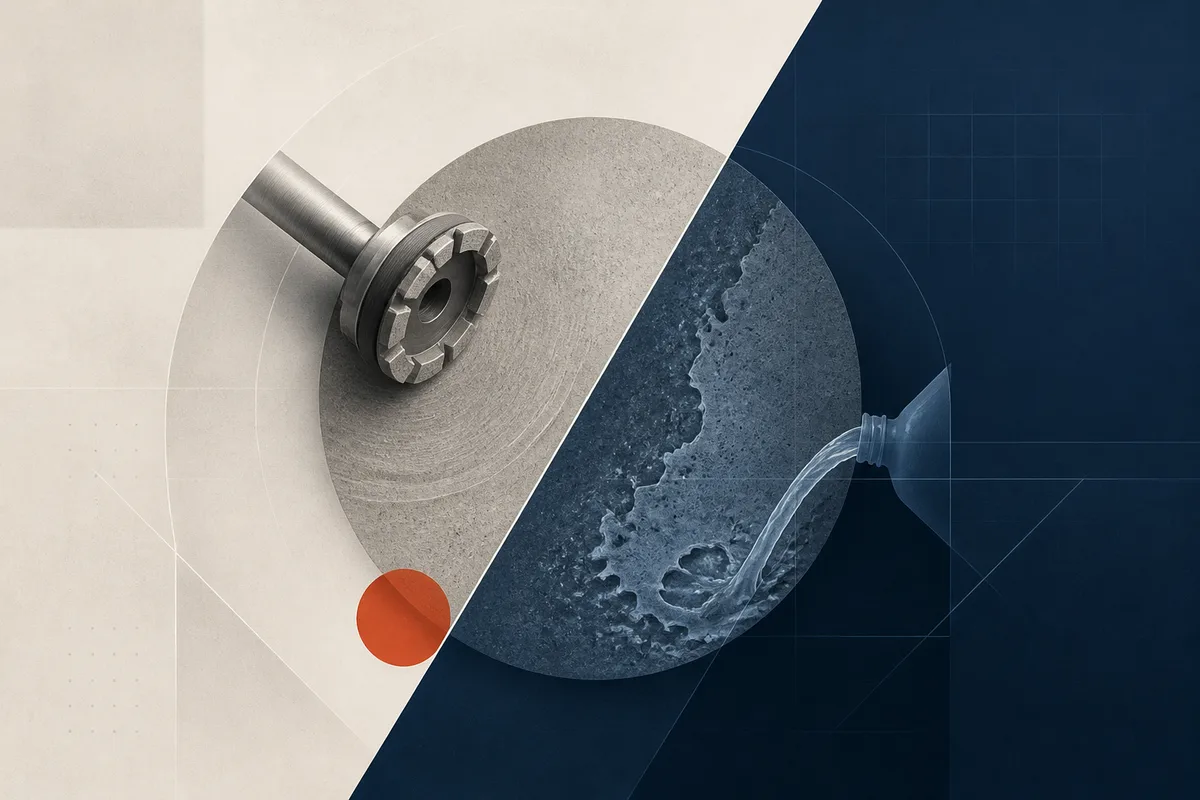
Diamond Grinding vs. Acid Etching: The Truth About Garage Floor Surface Prep
Most DIY epoxy kits fail not because of the paint, but because the preparation method is insufficient for the demands of a working garage. Acid etching is often marketed as a shortcut, but it relies on a chemical reaction that is frequently uneven, shallow, and neutralized before it can do its job. If the concrete does not feel like 80-grit sandpaper after prep, the coating is merely sitting on top of the surface rather than becoming part of it.
This guide breaks down the mechanics of diamond grinding vs acid etching garage floor preparation. Whether you are surfacing a residential bay in the South Tampa Service Area or a large-scale facility, understanding the physics of the bond will prevent costly delamination.
Why Chemical Prep Often Leads to Coating Failure
Acid etching uses phosphoric or muriatic acid to eat away the "laitance"—the weak, milky layer of cement paste on the surface. While this sounds effective, the process is fraught with variables that typically lead to a compromised finish.
- Existing concrete sealers or oil spots act as a shield, preventing the acid from ever reaching the concrete pores.
- The chemical reaction produces calcium salts that must be meticulously scrubbed and flushed, or they remain as a bond-breaking dust.
- Adding gallons of water to a garage floor in a climate where humidity reaches 82% traps moisture in the slab, potentially causing bubbles in the final coat.
- Etching does not level the floor or remove physical imperfections, meaning cracks and pits remain visible under the new coating.
The Mechanical Preparation Framework
Standard specifications for parking structures, such as those outlined by the City of Tampa, often detail rigorous surface preparation requirements to ensure durability. Following a mechanical playbook ensures the concrete is physically transformed to accept a high-performance resin.
1Achieve the Correct Concrete Surface Profile
The International Concrete Repair Institute (ICRI) defines CSP levels to standardize surface texture. For most residential and commercial coatings, a CSP 2 or 3 is required. Mechanical grinders use industrial diamonds to shave the top layer of the slab, ensuring the texture is consistent across the entire floor.
2Open the Pores for Mechanical Adhesion
Epoxy does not "stick" to concrete like tape; it flows into the open pores and hardens, creating a mechanical lock. Grinding removes the tight-troweled factory finish that characterizes most Florida garage slabs. This step is non-negotiable for Polyaspartic Floor Coatings which cure rapidly and require immediate penetration.
3Manage Dust and Contaminants
Modern mechanical preparation utilizes dustless concrete grinding systems. These units connect high-speed grinders to industrial HEPA vacuums, capturing particulates at the source. This eliminates the mess of wet acid-washing and ensures the slab is bone-dry and ready for coating immediately after the grind is complete.
4Address Structural Defect Repair
Grinding reveals the true state of the concrete, exposing "spider" cracks or spalling that acid hides. A technician can then use a rigid crack filler to bridge these gaps. Once the filler cures, it is ground flush with the rest of the floor to create a seamless, monolithic surface.
Why Mechanical Grinding Outperforms Etching
The primary reason to choose grinding is the elimination of "hot tire pick-up." When a vehicle drives on a floor that was only acid-etched, the heat from the tires causes the rubber to expand and grab the coating. If the bond is only superficial, the tire will literally peel the epoxy off the concrete as it cools and contracts.
Mechanical grinding increases the surface area of the bond by three to four times compared to a smooth slab. In a region where the heat index can reach 87°F or higher, the thermal stresses on a garage floor are significant. A mechanically profiled floor handles these temperature swings because the coating is anchored deep within the concrete matrix.
How Epoxy Garage Floor Tampa helps
A professional floor transformation typically begins with a thorough site inspection to test for previous sealers and moisture levels. A sound scope of work includes the removal of all existing paints or debris using planetary grinders, followed by hand-grinding all edges and corners where large machines cannot reach. Once the surface achieves a CSP 2 or 3 profile, the application of industrial-grade resins can proceed with the confidence that the bond is permanent.
Frequently asked questions
Can I acid etch a floor that has already been painted?
No, acid will not react with or remove old paint, epoxy, or sealers. It only reacts with bare, exposed concrete. To recoat a previously finished floor, mechanical grinding is the only reliable way to strip the old material and provide a fresh surface for the new coating to bond to.
How long does the diamond grinding process take for a standard garage?
For a typical two-car garage in South Tampa, the grinding and crack repair phase usually takes between three to five hours. This timeline depends on the hardness of the concrete and whether there are existing coatings to remove. Because it is a dry process, the first layer of primer or base coat can be applied immediately after vacuuming.
Is diamond grinding loud or messy for the rest of the house?
While the grinders are powerful, the use of industrial HEPA filtration systems keeps the process virtually dust-free. The noise level is comparable to large commercial vacuum cleaners. Unlike acid etching, there are no harsh chemical fumes or large volumes of wastewater that need to be managed or disposed of.
Why does my DIY acid-etched floor keep peeling under my tires?
This is a classic case of hot tire pick-up caused by poor adhesion. Acid etching often fails to create a deep enough profile, or it leaves behind a fine dust that prevents the epoxy from soaking into the pores. The heat from your tires softens the coating, and since it isn't anchored into the concrete, it pulls away when you back out of the garage.
Can diamond grinding fix an uneven or sloping garage floor?
Grinding can smooth out minor ridges, remove high spots, and level out small "lips" at expansion joints. However, it is not intended to change the overall pitch or slope of the floor, which is usually designed to direct water toward the garage door. If your floor has major drainage issues, specialized leveling compounds may be required after the initial grind.
What happens when you get in touch: you describe the situation, we ask the few questions that actually change the answer, and you get a clear scope and next step — no obligation.
Ready to move on this?
Pick the path that matches where you are today — the Epoxy Garage Floor Tampa team can take it from there.